A West Coast earthquake kit is built for two weeks on your own, not 72 hours: 14 gallons of water per person, 28,000 calories per person, a NOAA radio, a trauma-capable first aid kit, a battery bank or power station, sturdy shoes and a light under every bed, and a gas shutoff wrench you know how to use. Then anchor the water heater and the bookcases, because the shaking arrives before the kit matters.
Nobody on the West Coast needs convincing that an earthquake is coming. The USGS puts the odds of a magnitude 6.7 or larger in the San Francisco Bay Area at 72 percent within 30 years, and 60 percent for Los Angeles. What most households get wrong is the timeline, not the risk.
Earthquake preparedness on this coast is a two-week problem. Washington's Emergency Management Division tells residents to be two weeks ready, and Oregon runs the same standard through its Be 2 Weeks Ready program. Both are well past the old 72-hour advice, and everything below is sized to their number.
How Do I Prepare for a Major Earthquake at Home?
Prepare for a major earthquake at home in three layers: secure the house so the shaking does less damage, store two weeks of water, food, medical supplies, and power, and rehearse what your household does in the first minute and the first hour. Most people start with the third layer and skip the first, which is backwards, because anchoring furniture is the cheapest life safety work in the entire plan.
Start with the house itself:
-
Strap the water heater. Two straps and a plumbing kit protect 40 to 50 gallons of drinkable water and, more importantly, keep the gas line from tearing when the tank walks off its pad.
-
Anchor tall furniture. Bookcases, dressers, and the flat screen. If it is taller than it is wide and it is in a bedroom, it gets a strap.
-
Move the heavy things down. Cast iron, canned goods, and framed glass belong on low shelves, not above where anyone sleeps or sits.
-
Know your gas meter. Buy the wrench, tag it to the meter, and learn the rule below before you need it. We do not stock these; any hardware store carries a four-way or non-sparking gas valve wrench for a few dollars.
-
Get your shoes and a light under the bed. Broken glass on the floor is the injury nobody plans for, and it happens in the dark.
Then store the supplies, which is the section below, and finally write the plan: where the household meets, who calls the out-of-area contact, and who checks on the neighbor who cannot lift a door.
If you are building all of this from nothing, our 12-month preparedness buying order sequences the purchases so you are never spending on the wrong layer.
What Should I Do in the First 60 Seconds?
Drop, cover, and hold on where you are. Get to your hands and knees, cover your head and neck, and get under a sturdy table or against an interior wall away from windows. Do not run outside during the shaking, and do not stand in a doorway, which offers no more protection than the rest of a modern house. When the shaking stops, put on shoes, check the people around you, then check the building. Expect aftershocks and treat unreinforced masonry and brick chimneys as unsafe until someone qualified says otherwise.
What Is the Best Earthquake Preparedness Kit?
The best earthquake preparedness kit for a West Coast home is a household kit sized to two weeks, kept where you can reach it after the shaking, plus a smaller go bag in each vehicle. There is no single product that covers two weeks for a family. What works is a base kit for the medical, light, and communication layer, then water and food stored separately so one collapsed shelf does not take out everything.
Here is how we put it together, with current prices from our catalog:
|
Layer |
What we use |
Price |
|
Base household kit |
$309 to $459 |
|
|
Information |
$79.99 |
|
|
No-cook food |
Heaven's Harvest 1-Month Combo Kit, 308 servings, 48,480 calories, water only |
$871.17 |
|
Cheaper calories, if you can boil |
Augason Farms 30-Day 1-Person Premium pail, 307 servings |
$128.99 |
|
Heat and fuel for the boil-capable food |
Fire and warmth, ferro rod and a fuel stove |
from $25.95 |
|
Water |
from $21.33, 8-pack $159.55 |
|
|
Medical |
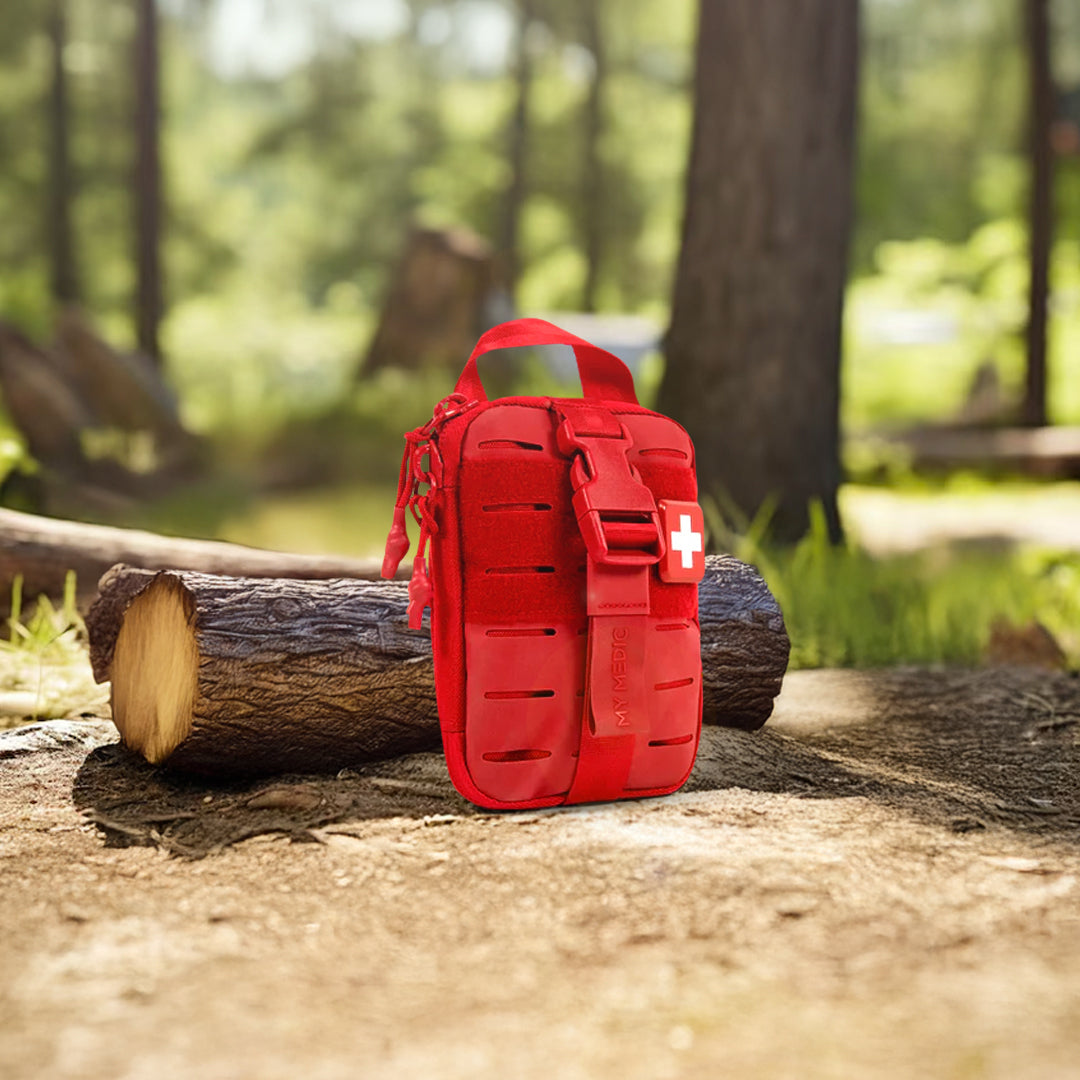
My Medic Sidekick, MediTac for the trauma layer |
from $74.95 |
|
Power |
$1,099 |
|
|
In the car |
$119 to $169 |
|
|
Pets |
The Safe Pet Kit, dog or cat |
$129.99 to $139.99 |
The base kit is the 72-hour layer, and that framing is deliberate: it covers the first three days of medical, light, tools, and sanitation, which is the window where a kit earns its money. Two weeks of water and calories is a storage problem, not a kit problem, and it costs less per day than the kit does.
The car bag matters more here than in most of the country. A quake at 4pm on a weekday puts a lot of West Coast households on the wrong side of a bridge or an overpass from their supplies, and the full kit range is built around that split.
What Should I Have Stockpiled Before a Major Earthquake?
Stockpile two weeks per person: 14 gallons of water, about 28,000 calories of food with the no-cook layer bought first, two weeks of any prescription medication, and the sanitation supplies for two weeks without working plumbing. Washington's guidance is one gallon of water per person and per pet per day, and that gallon covers drinking, cooking, and hygiene, not just thirst.
Water. Fourteen gallons per person means 56 gallons for a family of four, and pets count. Split it: some in the house, some in a second location, none of it stacked where a single wall failure buries all of it. Add a filter, because municipal water can be unsafe or absent for weeks after a major quake even where pipes survive.
Food, and here the order matters. At 2,000 calories a day, two weeks is 28,000 calories per person. Buy the layer that needs no cooking first, because your gas may be off and your stove may be unusable: a Heaven's Harvest 1-Month Combo Kit at $871.17 is 308 servings and 48,480 calories that rehydrate with water alone, which is two weeks for one adult with margin, or two adults for twelve days.
Then add the cheaper calories behind it. The 307-serving Augason Farms pail at $128.99 is rated by the manufacturer at 1,854 calories a day for 30 days, about 55,630 calories, which very nearly covers two adults for two weeks and costs roughly an eighth as much per calorie. The catch is real: most of that pail is mixed with water and simmered for 12 to 15 minutes, so it only counts as food if you also own a way to boil water without the kitchen. Budget a ferro rod and a fuel stove alongside it, from $25.95.
Two Augason pails gets a family of four to about 111,000 calories against a 112,000 target, so round the rest out with bulk staples and food from your own pantry. Our 30-day pantry test covers what a family actually eats when the plan meets real life.
Sanitation. Two weeks of no plumbing is the part of a quake nobody rehearses. Heavy-duty bags, a bucket, cat litter or a chemical treatment, gloves, and wipes. This is cheap and it is the difference between an uncomfortable two weeks and a household illness.
Power and light. Phones are how you reach family and how ShakeAlert reaches you, so a battery bank is a minimum and a power station is better if anyone in the house depends on a medical device. Our power station versus generator breakdown covers which one fits a two-week outage.
Medical. A basic first aid kit does not cover crush injuries, deep lacerations from glass, or fractures. Trauma supplies, pressure bandages, and a tourniquet, plus the training to use them, because professional help will be triaging.
Documents and cash. Insurance policy numbers, ID, and small bills. Card readers need power and networks, and neither is guaranteed.
Why Two Weeks and Not 72 Hours
The 72-hour number comes from disasters where roads work. A subduction zone earthquake does not leave roads working. The widely cited figure for southern Cascadia is a 37 percent chance of a magnitude 8 or larger within 50 years, from Goldfinger and colleagues' 2012 turbidite study, which Oregon State University summarised as roughly one in three. Separately, USGS puts the odds over the next 50 years at 10 to 15 percent for an approximately magnitude 9 rupture of the full Cascadia Subduction Zone, 85 percent for a magnitude 6.5 or greater deep quake in the Puget Sound region, and 17 percent for a magnitude 6.5 or greater crustal fault quake there. Those are forecasts, not predictions, and they are why both states now run a two-week standard.
California's risk is different in shape but not in consequence. A Hayward fault rupture damages bridges, water mains, and gas distribution across the East Bay at once, and repair crews work a queue. The household that can go two weeks without asking anyone for water is the household that is not in the queue.
The Mistakes That Wreck Earthquake Plans
-
The unstrapped water heater. It is 40 to 50 gallons of stored water, a gas line, and a flood, all decided by two straps you can buy for less than a dinner out.
-
All the supplies in the garage. Garage walls rack, garage doors jam without power, and the shelf above the car is the one that dumps. Split the stores.
-
Shutting off the gas out of reflex. Shut it off only if you smell gas, hear hissing, or see the meter dial spinning fast. Once it is off, only the utility can restore service, and after a major quake that queue is measured in days or weeks.
-
No shoes, no light, under any bed. Every quake account includes someone crossing a floor of broken glass barefoot in the dark.
-
Water stored, filter forgotten. Fourteen gallons runs out on day 14, and the tap may still be unsafe.
-
A 72-hour kit and a two-week problem. The kit is the first layer, not the whole plan.
-
Nothing in the car. A weekday quake separates a lot of households from their house.
-
Two weeks of food that needs a stove, and no stove. Dehydrated pails are the cheapest calories on the shelf and most of them want a 12 to 15 minute simmer. If the gas is off and the power is out, that food is inventory, not dinner. Either buy the no-cook layer first or buy the fuel with the food.
-
Alerts that depend on a charged phone. ShakeAlert and county alerts are useful and they are not resilient. A hand-crank NOAA radio is the backup that does not care about the cell network.
An earthquake plan is not complicated. Anchor what falls, store two weeks of water and calories, keep a light and shoes where you sleep, put a bag in the car, and write down where everyone meets. None of it takes a weekend. All of it is the quiet work, done before anything goes wrong.
Start with Disaster Preparedness for the household layer, or read our one-year food supply guide if you want to build past two weeks.
FAQ
How do I prepare for a major earthquake at home?
Work in three layers. Secure the house first: strap the water heater, anchor tall furniture, and move heavy items to low shelves. Store two weeks of supplies second: 14 gallons of water per person, about 28,000 calories, medication, sanitation, power, and a trauma-capable first aid kit. Rehearse third: drop, cover, and hold on during shaking, shoes and a light under every bed, a household meeting point, and an out-of-area contact everyone can call.
What is the best earthquake preparedness kit?
For a West Coast home, the best setup is a household base kit plus separate two-week water and food storage plus a go bag per vehicle. We build it around The Safe House 72-Hour Family Emergency Kit at $309 to $459 for the medical, light, tools, and sanitation layer, a Kaito KA700 NOAA radio at $79.99 for information, and The Safe Trail Go Bag at $119 to $169 for the car. No single kit covers two weeks for a family, and any product that claims to is selling you a serving count.
What should I have stockpiled before a major earthquake?
Per person: 14 gallons of water, roughly 28,000 calories of food, starting with the layer that needs no cooking, two weeks of prescription medication, and sanitation supplies for two weeks without plumbing. Add a water filter, a way to boil water if any of your food needs it, a battery bank or power station, a trauma kit, cash in small bills, copies of insurance and ID, and pet food and water at the same one-gallon-per-day standard. Store it in at least two places so one failure does not take all of it.
How much water do I need for an earthquake?
One gallon per person per day for 14 days, which is 14 gallons per person and 56 gallons for a family of four. Pets count at the same rate. That gallon covers cooking and hygiene as well as drinking. Because water mains and treatment plants can be down or unsafe for weeks after a major quake, pair stored water with a filter rather than relying on storage alone.
Should I turn off the gas after an earthquake?
Only if you smell gas, hear hissing, or see the meter dial spinning quickly. Otherwise leave it on. Turning it off is easy with the right wrench, but only the utility can legally turn it back on and safely relight appliances, and after a widespread quake that wait can run days or longer. Keep a wrench tagged at the meter and make sure more than one adult knows the rule.